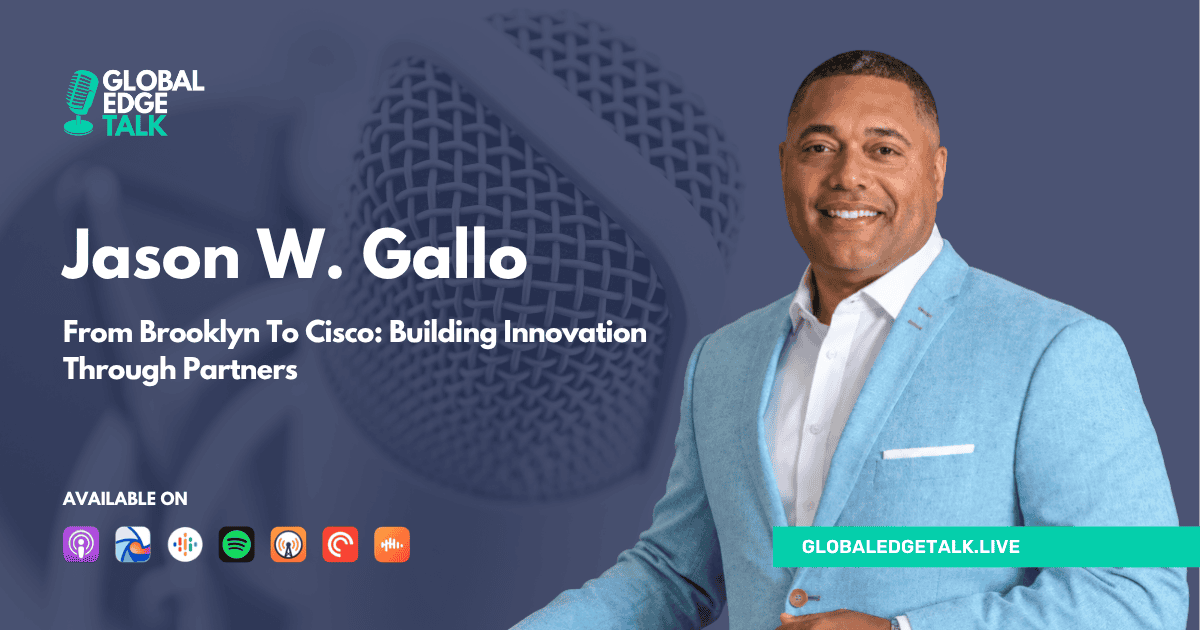
Building innovation inside a giant company sounds like a contradiction until you hear how it actually gets done. We sit down with Jason W. Gallo, Vice President of Cisco’s Partner Go-to-Market Acceleration, to trace the path from Brooklyn Tech roots and an engineering mindset to leading transformation across one of the world’s biggest partner ecosystems. Along the way, we get honest about what changes when you climb the ladder: the job stops being “having the answer” and becomes knowing when to let go, delegate, and shape culture without crushing the team’s creativity.
We also dig into the Cisco 360 partner program and why it qualifies as a true corporate maverick move. When you work with about 35,000 channel partners and most revenue flows through the channel, changing governance, incentives, and operating rhythms is not a small tweak. Jason explains why Cisco chose to co-design the new program with partners, even announcing changes before everything was fully finished, and what that kind of openness demands from leaders and from partners who want to stay relevant.
Then we take on the AI question everyone is asking: elimination or opportunity? Jason’s take is direct, practical, and a little uncomfortable. AI may not fully replace humans, but people who use AI well will replace those who don’t. He shares how reskilling looks in the real world, why “playing with ChatGPT” is not the same as understanding AI, and how he used Claude to build and publish a simple app to GitHub after not coding for 20 years.
If you care about partner strategy, go-to-market execution, AI reskilling, or leadership growth in tech, this conversation will give you frameworks you can use immediately. Subscribe, share this with a colleague, and leave a review with the one skill you’re committing to build next.
Alex Romanovich 0:30
Hi, this is Alex Romanovich and welcome to Global Edge Talk. Today, on August 4th, 2026, we are with Jason W. Gallo, who is the vice president of Cisco’s Partner Go to Market Acceleration. Welcome, Jason.
Jason W. Gallo 0:48
Thank you. Great to be here.
Alex Romanovich 0:50
Great to have you here. Before we jump into the meat of the conversation, I want to introduce you properly because I think your background speaks for a lot of different things in terms of innovation, in terms of go-to-market, in terms of what true leadership in technology innovation should be all about. And in time in times of artificial intelligence, in terms of so much change that’s taking place right now. You’re also helping the entire ecosystem with partnership strategies, marketing strategies across the entire Cisco’s core growth areas. And you’re well known in the company and outside of the company for your ability to combine business vision, financial discipline, which is always very important, and technology innovation. And you obviously focus on outcomes, which is, you know, you’re supposed to, and it’s uh extremely important. But uh with outcomes comes the responsibility. It comes with the responsibility as a global leader with deep partner network and deep partner expertise. And I love your global background. We talked a little bit about the globes you have in the back. You’ve done business in more than 20 countries, uh, and that’s uh very, very amazing. Uh maybe you want to add something to your background that could be relevant, but I don’t want to steal any thunder from you, and then we’ll jump into questions. Awesome. No, we can jump into the questions and thank you for the kind introduction and happy to be here with you and your audience. Wonderful. Uh in that case, why don’t we jump into uh some of the questions because uh um as somebody who has been not only well traveled but uh somebody who has uh attended some amazing educational institutions, whether it’s University of Chicago, Booth School of Business, uh, or Rochester Institute of Technology, your background takes us all the way back to Brooklyn, New York, which is where I grew up. Tell us more about your childhood, your early days of your career, the Brooklyn days, and some of those things that shaped your um amazing career, shaped your passion for innovation, shaped your passion for uh growth and uh discovery.
Jason W. Gallo 3:42
Yeah, absolutely. And uh thank you for mentioning that. I always like to say I’m I’m just a kid from Brooklyn, and uh while I’ve had the opportunity in my life to see some pretty amazing things, uh it really all started as the 1980s version of Brooklyn and what that looked like. You know, I saw my uh father preach to crowds at Yankee Stadium. Uh my mom was actually the third New York City sanitation woman ever and a 9-11 first responder. Uh, and I sometimes talk about my grandparents. They were entrepreneurs, they had a uh furniture store, uh, and it was where I had my first job learning how to sell uh genuine simulated wood. So uh that was also where I guess I learned some marketing. And it was just a great upbringing in Brooklyn. Um, went to high school there, uh same high school that my wife went to. We met a little bit later in life, but we actually uh were there at the same time. So I owe a lot to Brooklyn and always uh while I live in the DC area now and like instead of traveled the world, uh, I definitely see myself as a Brooklyn guy at heart. You can see the uh the New York Mets uh hat behind me. So I try and stay close to my teams. Which high school, by the way, did you go to? Uh Brooklyn Tech. So it’s a uh special school in uh New York, and uh it’s just uh created a great foundation. Uh it was one of the schools that um you pick a major in high school. And uh my mom told me that she wanted me to be an electrical engineer. I’ll be honest, I didn’t know what that was, um, but we picked that in high school, and you know, that uh was the thing that uh launched my career into the technology space. So very thankful for Brooklyn Tech and having that major, but also thankful for my mom to uh push me to explore what uh this engineering thing was all about.
Alex Romanovich 5:31
Uh and I love this interview for a couple of reasons, because first of all, my son is a graduate of Brooklyn Tech. No, number one. Second of all, he is now a uh a student at SUNY Albany with electrical engineering major. And thirdly, because I went to Politech, Brooklyn Politech, with electrical engineering major myself. Right down the show. So let’s talk about let’s talk about the uh engineering days, right? Um uh which is very important, I believe, especially for the times we’re in right now. Right? So you uh started as an engineer, you went through the ranks of VP and C level executive, and um uh you know, as an engineer architect, you moved to marketing, something very similar to what I did at IBM. And um, you know, my first year of business, so that shift was rough. What was the hardest one for you, just out of curiosity?
Jason W. Gallo 6:22
Yeah, I I think um it wasn’t so much the functional shift, because I I think the grounding and understanding problem solving uh from the engineering background translates very well through to any role that you have. I I think those of us who have that engineering background, um, we hold on to those roots of uh problem solving. And in today’s environment, uh familiarity with uh technological concepts and and how they can be used to help us in our our day-to-day activities, to help our teams, to help our companies, whatever it may be. Uh so that wasn’t as much of a transition as much as it was equipping me for the future. I think where the transition I felt um happened um as a growth opportunity, I’ll call it, uh, was understanding when to let go. And I think as you get more into uh a leader or a management level, you have to delegate responsibilities more than you ever have, particularly if you pride yourself on being an engineer who knows the answers. Um sometimes you can actually see the answer, but you have to let the team fail and give them a chance to grow in their own ways. Uh, and and they might surprise you. They might actually come up with some new ideas or brand new ways to look at something that um, you know, it’s it’s more um modern or revisited uh from something that uh you may have tried in the past. And so I think that idea of moving from individual contributor who is looking at the data and the insights to a director level or mid-level where you’re trying to drive execution to a vice president where you’re you’re you’re wrapping your head around strategy and you’re starting to expand the aperture to truly into that you know higher level C level or SVP, where you’re now trying to shape culture. Um, that part of the transition of you’re you’re letting go and creating more of a boundary for the team to accomplish things uh versus being the person who gets the exact specifics around the insight.
Alex Romanovich 8:33
A lot of folks are very skeptical about innovations inside of a very large organization, even the technology one, like Cisco. Um but you call yourself a corporate maverick. Uh when we spoke a couple of times, and um I’m just curious to find out, and our audience will be curious to find out what is the one decision as a Maverick inside of a very large organization that you made that kind of surprised everybody?
Jason W. Gallo 9:01
So I’ll give you one that I think is uh is quite relevant but also recent, uh, which is we recently launched the Cisco 360 partner program, and it was very transformative. Uh if you can imagine a company taking a uh a program or an initiative that has won many awards, has been multiple decades worth of being the leader in the industry. Uh, Cisco had been known for its partner program and building out true partnerships and ecosystems, and then being asked to transform that and being at the forefront of uh making some of those decisions. That that felt a little bit like being a maverick, I have to admit. Um, because you’re trying to modernize something that was proven, uh, especially across a partnership. Uh, we have about 35,000 partners that we do business with, uh, and around 90% or so of our uh all of our sales goes through that partner network. So fundamentally changing the governance, the policies, the rewards and recognition systems, the operational elements uh behind that uh was no small undertaking. And yet we realized that we had to evolve. You know, the the market uh is asking different questions of uh technology vendors nowadays, and that includes our partners as well. And so, you know, we looked at it as it was the hard decision of, you know, think of ripping a building down, not just to the studs, but starting from the foundation back up because we can build a new modern structure, um, but never leave anyone behind on that journey and make sure that this you know partner network of 35,000 or so companies uh can come along with us. And so there were some pretty specific things we did. Um, another Maverick move within that Maverick move uh was we announced the program changes before they were done. And I think, you know, uh traditional uh playbook would tell you you button everything up, it’s finalized, and then you bring it out to market. And we took a decision that said, we’re going to co-design this uh with our network of partners. And that was really uh tough Maverick style decision, back to your term there, um, because it’s you’re unsure, particularly with a change this big, of what the outcome is going to be uh if you’re truly allowing your partners to design it with you. Uh and there might be asks or things that are needed that come from that outside in approach that you hadn’t anticipated. Uh and so we, I would say we’re very brave in uh taking that leap. Um, but ultimately, as we’ve seen from January when it was uh launched until now, it was a much, much, much better outcome uh as we allowed this uh transformation not to cause us to have a closed uh uh ecosystem or closed-minded innovation, uh, but quite the opposite, to co-design it uh with the community at large.
Alex Romanovich 12:22
Um obviously our conversation would not be complete without um artificial intelligence. You know, I mean that’s uh that’s a given, right? It’s a given. Um and I’m pretty sure that part of that innovation and that maverick move um was AI. Um the public conversation and the conversation inside of large organizations, especially the ones with scale with you know thousands or tens of thousands or even hundreds of thousands of employees, is uh the conversation swings between, hey, AI can potentially eliminate jobs uh versus AI can create more than it takes. And even if uh some of those jobs would be eliminated, let’s not, you know, let’s not um argue about that because that’s gonna be the case in almost every large organization, right? Um, what is the version that you believe? Is it purely elimination and replacement, or is it something that you can build on as a foundation?
Jason W. Gallo 13:29
Yeah, it’s it’s absolutely the latter, in my opinion. Um, I think the jury is still out to your point, not whether there will be impacts, um, but how that will play out, the um changes that it will bring about. Uh, and I’d say I believe two things. First, I do believe that there’s a significant number of new jobs that will be created. And if you look over the longer-term horizon, um, technology has proved that time and again. Even 10 years ago, there wasn’t a role like a cloud architect, uh an influencer or a social media manager. I recently heard there’s like a bachelor’s of uh influencer social media influencer now, right? Um, prompt engineering, you know, these types of roles came about as the technology uh has evolved. And I think that same thing will happen uh with AI. However, I also believe, to your point, there is a counter uh balance to that, which is that while AI may not completely replace humans, the people who are using AI will replace those other humans. Um, and I think we’ve also seen that, you know, history has taught us that as these large technological transformations have happened, um, you know, the spreadsheet didn’t replace accountants, but accountants and and finance people that know Excel certainly can replace those who do not. Uh, and I think we’ll see that play out again here in the short-term impacts as there is a reskilling, uh, a new set of talent that has to evolve. Uh, my daughter recently started uh Penn State and is going for a Bachelor’s of Artificial Intelligence. You know, that bachelor’s degree didn’t exist uh in schools uh 18 months ago. And in fact, it’s one of the reasons we picked Penn State, even though she got into uh several other, you know, uh well um known schools, but they differentiated themselves by having a career path uh in artificial intelligence. Uh and so I think you’re already starting to see those early in career roles and jobs and academic institutions uh put in place the pathways for artificial intelligence jobs.
Alex Romanovich 15:47
Absolutely. And you know, as a as a former engineer, I always get excited about those opportunities. And they’re very different opportunities, by the way, now, especially for the um younger generation, uh, our kids, you know, and so forth. And um, one of the reasons that my son chose electrical engineering with the potential of switching to mechanical engineering was robotics, was um hardware, uh the way it’s being designed right now. I mean, a lot of skeptics are out there saying, you know, how could AI work with the hardware company? Right? And uh, you know, and my answer to that as a former microprocessor engineer at IBM and Intel is look at NVIDIA, right? Look at Cisco, right, when you think about it, right? Um, anything from algorithms to managing a partner ecosystem to routing protocols to you know embedding that on the chip, you know, you name it. Um, but let me let me ask you this question about the partnership. Let’s go back to a partner ecosystem. Sure. Today, with the new partnership program, with new technologies available, new products available, the um the demands of a partner for somebody like Cisco, which is becoming a very sophisticated organization in terms of tech and in terms of the way it delivers tech, um what is what should the partner do today that’s different from yesterday?
Jason W. Gallo 17:18
Yeah, so a couple things uh and and the new program really emphasizes that you know in the past, I think not just Cisco, but partner programs overall would emphasize uh a set of training. And and that was you know the extent of it. And that’s a great foundation. I think every company uh needs to uh remain on top of the technology as it’s evolving faster and faster. Um but we added a couple dimensions. Uh we added on top of that layer of understanding the capabilities and having the training and the people on staff, um, an element of performance. And are you keeping pace with the market? Are you helping support the broader ecosystem uh as we all look at the market share and and and as that shifts? Um the next area that we looked at was all around engagement. With a lot of these technologies, what we’re finding is um it’s moving so fast that sometimes the customer uh doesn’t have a real methodology on absorbing it. You know, how many times have you uh purchased something, and by the time you fully get it used or or you know, taken advantage of it, it’s already outdated. Uh and so the opportunity to adopt it, to have a life cycle approach, uh, for our partners to engage their customers in a new way and for us to be able to effectively measure that uh was another skill and a part of their business operating model that we felt uh was critical to highlight. And then there were a couple of foundational elements. You know, business isn’t monolithic anymore. Uh some partners are integrators while they’re simultaneously managed service providers, while they’re simultaneously developers and creating their own code, uh, while they’re simultaneously doing professional services and um advanced liquid cooling installation at data centers uh around the globe. So we we had to come up with a foundational level that said have a solid business understanding of these different ways in which you can uh operate as a company. And so that foundational capabilities, performance, and engagement, the four categories I just described, uh became what we see as the partner of the future uh who can remain agile and have an effective uh business model.
Alex Romanovich 19:46
Absolutely. And um, you know, it is uh it is not only challenging, obviously, for the partners today, because they have to um they have to get their own skills in order, they have to advance, they have to innovate. Um, it’s also challenging uh or more challenging uh for Cisco to make sure that they’re dealing with the right partnership and the right partner ecosystem. And of course the tools will help, but it’s ultimately up to the humans to decide. Um now let’s let’s enter Jason W. Gallo as the global um as the global guy. Okay you’ve worked across a lot of markets, you’ve opened a lot of markets. Um, where have you seen the practice that works in one country fail completely miserable in another country? And what did that teach you and teach them um in terms of, hey, can innovation really travel well?
Jason W. Gallo 20:46
I think it’s a fantastic question. Um and I think it’s a humbling reminder for for those of us uh in that space of innovation that it’s not just about the product. You can launch something that is fundamentally amazing innovation, um, but if it doesn’t land with the people, uh, with the social dynamic, uh, with the uh interests of the society, and you can’t connect to the use cases that uh they really care about, then it’s really just great technology that’s probably sitting on a shelf somewhere. And I would tell you one stark example, um, which I think there’s been many books, even movies written about, is Japan. And so I use that just because it’s very familiar, but there’s a lot of other cultures that I’ve I’ve seen this. Um but the commitment in terms of rolling out innovation in a culture or country like Japan is that it has to be precise and it uh should come out right the first time. And funny enough, as I mentioned earlier, uh with the Cisco 360 partner program or even with some of our technologies that we’ve launched, uh, that co-design element where we’re actually launching something that’s probably not finished. Um, it’s kind of how technology works. It’s a little messy. There might be a beta version. Everyone knows, you know, uh when things first come out, we’re we’re quickly iterating to get the uh the next version. And um, it’s an often uh used technique in the technology space, yet in the Japanese market, it can uh Um, land quite poorly if the thing that you bring to market requires a very long journey to get it to, you know, a stable, uh uh relevant, useful tool, uh, because it’s seen as you’re not keeping your word. And so you have to be quite cautious uh in those markets where co-designing with me is not as welcome as get it right the first time and offer me a technology that you’ve already thought through. And and neither one of those approaches are wrong. Um, but I think having the cultural sensitivity to understand where you’re doing business and setting expectations uh with those customers and those partners that you are uh effectively putting out there in front of your customers uh is a fundamental requirement for being successful.
Alex Romanovich 23:18
I love that example. Uh, having spent uh at least three to four years in Japan and working with the Japanese executives, it’s almost like you have to, yeah, the American approach is uh, hey, vibe coding, vibe manufacturing, vibe innovation, right? And uh in some cases, uh maybe Japan has uh a few lessons to learn, not only from the US, but also from China as an example, right? Um now you’re you’re not only an innovator, you’re not only an executive at Cisco with a great engineering background, great technical background, but you’re also a mentor. And um you’re uh coaching a number of folks as well. Um you have a you know a wonderful family and kids, I’m sure you’ll be coaching them as well. Um what it’s what are some of the questions they ask you, the the folks that you’re coaching, that may surprise you sometimes? And what is that answer?
Jason W. Gallo 24:18
So I would say as a leader, and for all your listeners uh out there, it’s really important to um think about the different experiences of the generations within the workforce. And so I do mentor and coach uh several different individuals who are at different stages of their career. And I will tell you the millennials have a focus on very quick when I try to get promoted and and you know, how do how do I get me in the right spot? Uh, and that’s okay, right? But meeting them where they’re at. So if that’s the coaching discussion, then let me show you where that gratification can come from and create reward systems that allows them to see that uh gamification of activities. And, you know, we do that in some of our um uh HR and feedback systems that we’ve you know adopted that are uh I would say a lot more modern. Um some of the Gen Zs and others, I would say, you know, my daughter and and and my son are kind of at the tail end of that. Um, but that generation went through the pandemic. And there are things that you have to think about in terms of um anxiety and and social norms and you know, what does it mean to be in a setting where as you start your first internship, your first job, you’re not necessarily in an office? And so if you’re already had gone through something where uh that social uh pandemic setting, and now you’re entering a workforce where you’re still not in a group of people, let’s say, um, how is that affecting your ability to network and create those career connections? And uh how do you, as a mentor and a leader, uh quite intentionally put them in a position where job opportunities, career growth is done. And that generation is dealing with, as we talked about earlier, AI, which is uh optimizing out some of the entry-level tasks. And so having the ability to think and quickly get them to uh accelerate to using AI as a teammate, not just a tool, uh becomes critical. So I I guess I go back to coaching is really about understanding who you’re coaching first. Um there’s there’s a uh um uh concept that we use here at Cisco. Uh one of the uh uh HR leaders, or we call it people and communities leaders, uh, Alex Allen talks about proximity. And coaching isn’t just I’m going to impart all of my wisdom upon you. It’s really about how do I get proximate to who you are first? And that proximity can allow me to tailor some of the experiences or maybe things that I can pass on uh in a way that doesn’t crush your spirit, uh, it doesn’t, you know, derail, you know, you have to fit this mold. Um, but it’s more hand holding and meeting you where you’re at.
Alex Romanovich 27:24
Um for somebody who has a technical background, engineering background, and then switch to the business side and marketing side and go to market side, um, what is your advice to someone in the technical world, if you will, who’s now beginning to use some of these AI tools like Cloth Code or chat uh and and some of the other ones. Um because it was not, you know, it’s not enough for them to switch to a different career path. They’re in the same career path. The problem is a lot of that responsibility that they used to have is being taken away from them, it’s being taken away from them by the sophisticated tooling, by agents, potentially, right? So, what is your advice to them, uh, other than hey, switch the career and go to marketing and sales and and try a luck there, right? But what is your advice to those folks that are probably wondering, my goodness, you know, am I working to eliminate my own job?
Jason W. Gallo 28:36
Yeah, it’s it’s it’s similar to the question we had earlier, but I I guess the only um uh fundamental advice that uh I can give and everyone continues to give is um reskill yourself, make sure you really understand the tools. Um by the way, playing with Chat GPT is not knowing the tool and not really understanding AI. Uh it’s funny how many conferences you go to and you ask the audience, how many of you um use AI every day? And everyone raises their hand. Often are talking about some sort of a chat bot or something, and then you ask how many have done uh coding and Claude, and you know, more than half of the hands go down, even though they’re in technical roles. Um, and so what I would say, uh, I recently uh had the same thought process, and I was like, Well, am I falling behind? My goodness, I I’m out here telling everyone else not to fall behind. What do I do? And uh I went uh played around. I think there’s multiple models. I personally just played around with uh Claude on the uh a few weekends, and within one afternoon, I you know, granted, I hadn’t coded in 20 years, let’s be clear. Um, but I came up with an app. And in fact, the app I came up with, I asked Claude, come up with a curriculum of how you would teach me, Claude. It came up with a whole plan. Turn that into an app that I can then click as I go through the modules that you created. And then just for giggles, I figured, well, how do I get this out to the rest of the world? In that same afternoon, I published that app out to GitHub and created the connectors. And again, I hadn’t coded in 20 years. Um, but it taught me in an afternoon that I can use some of these tools in a way that the logic that I have picked up, whether it’s network logic or um uh you know coding logic, that logic is still important. But the routine tasks at the code level, you can augment some of that with tools uh like Claude or again other models that might be out there. And so it it serves as probably two lessons. One, move quickly and and start to, you know, the best place to start is to start, right? Um and at the same time, the underpinning logic that you’ve picked up and the experience that you have, whether that’s you know, someone early in career picked it up in college, or whether that’s someone later in career who is seasoned and has seen uh different problem statements that they’ve solved, you still um have a value and just applying some of that logic with the use of a tool that can accelerate the ultimate outcome with AI.
Alex Romanovich 31:31
I think it’s a it’s such an important um example you just gave, not only to um a global executive like yourself, but also to an entrepreneur who’s trying to get the business going or partner with a company like Cisco or something like that, is and trying to understand how they can leverage their knowledge, their experience, uh, and package it maybe even into something that’s visible, something that could be uh monetized quicker, um, and so forth. Now let me ask you a um two final questions. Okay. Maybe maybe maybe uh provocative in nature. Um you’re back in Brooklyn, you’re um you’re walking on the street and you see um young Jason on the other side. You um you offer to buy him coffee and sit down with him for a half hour. What do you tell him? Great question.
Jason W. Gallo 32:31
Um so I would say probably the same thing I’ve I’ve uh been telling my my children. Um one, get better at your golf game because it’s really hard to do it later in life. I’m I’m experiencing that right now. Um but uh two, I think fundamentally, you know, have a balance in life. You can uh very quickly move to a place where um your pursuit of career or uh wealth or whatever it may be, um, can get out of balance. And so um my advice to my younger self would be something that I I came up through hard-fought experience, which is uh if you can achieve a balance between spirituality, health, love, wealth, power, and wisdom, all six of those, it ultimately leads to your personal happiness. And I don’t think everyone’s balance is the same, so it isn’t about replicating something that others have done. It isn’t necessarily um a right or a wrong answer of what you know, putting additional emphasis on spirituality versus love means. Uh, and I think there’s a lot in each of those um specific pillars, but whatever that formula is for you, um, find a balance and it’ll all work out and lead to happiness. But I think there’s a lot of things along the journey from a uh a kid who didn’t know much from Brooklyn to a uh a global executive that is contained in that spirituality, health, love, wealth, power, and wisdom uh that I wish I would have learned maybe a little bit sooner. And uh that’s the advice I’d give my younger self.
Alex Romanovich 34:37
I love that. And uh that that’s a very happy and um very thoughtful uh conclusion of our conversation. I want to thank you, Jason, for being an innovator, uh for coaching, for uh mentoring, for passing on the legacy of the balance, if you will. And I think it’s an amazing um it’s been an amazing experience talking to you. We want to wish you lots and lots of success. Awesome. Thank you, Alex, and thank you to all your listeners.
Jason W. Gallo 35:09
Thank you.
Toggle Content