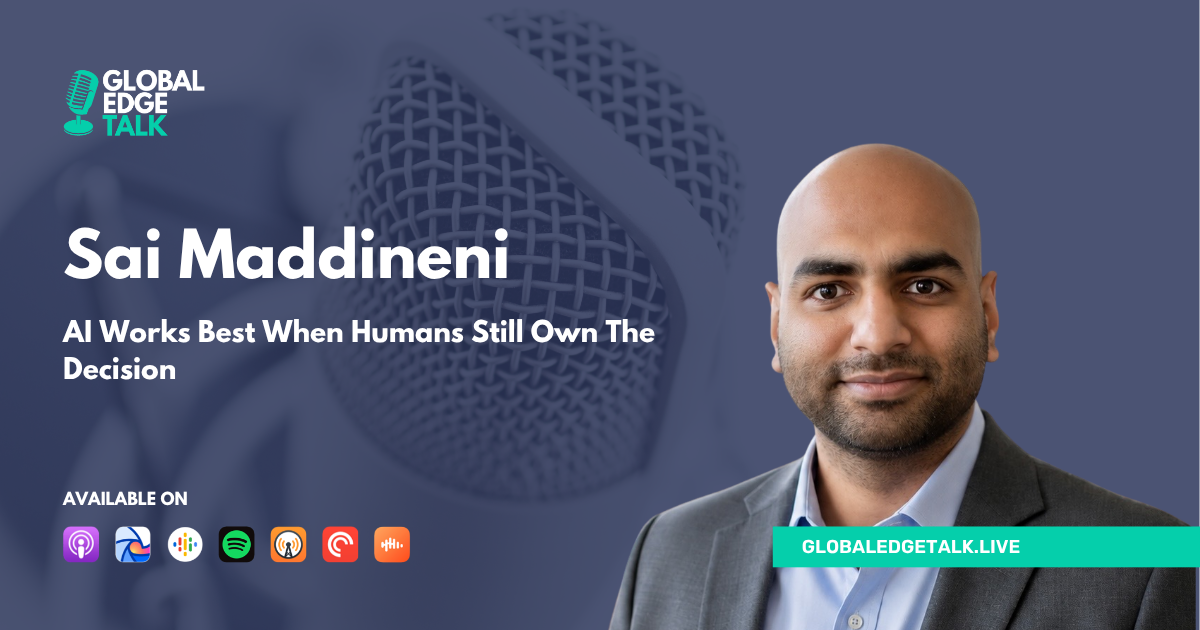
AI is everywhere, but commercial insurance is one of the few places where the consequences force honesty. When underwriting decisions and claims can swing by millions, you can’t simply hand responsibility to an “agent” and hope for the best. We sit down with Sai Kiran Maddineni, Staff Vice President for Product at FM Global, to talk about what AI actually changes in commercial property insurance and reinsurance, especially as data centers and advanced manufacturing explode in scale and complexity.
We dig into how FM uses AI to scale human intelligence rather than replace it, leaning on decades of engineering insight and loss data to surface patterns faster and deliver more consistent risk assessments. We also unpack the gap between AI marketing and operational reality: automation sounds flashy, but augmentation is where value shows up today through faster information retrieval, document summarisation, change detection across policies and properties, and better prioritisation of expert work. Throughout, we keep coming back to the same non-negotiable: accountability still needs a name attached to it.
The conversation also gets personal and practical for your career. Sai explains what consulting prepared him for and what it didn’t, why global capability centers are reshaping how companies build internal tech muscle, and how legacy modernisation becomes even more urgent in the AI era. If you’re worried about being replaced, navigating a pivot, or recovering from a layoff, you’ll hear grounded advice on defining your role before the market defines it for you, building adaptability, and using AI to amplify your output instead of fearing it.
Guest: Sai Kiran Maddineni, Staff Vice President, Product, FM Global
Alex Romanovich 0:30
Hi, this is Alex Romanovich and welcome to Global Edge Talk. And today we're talking to one of our guests, staff vice president for product at FM Global, Sai Kiran Maddineni. Hello, Sai.
Sai Maddineni 0:40
Hi Alex.
Alex Romanovich 0:41
Welcome to our studio. you know, when I first thought spoke to you, I was amazed to learn that FM is not a young company, FM.com, which is amazing. First of all, I was amazed at the fact that you were able to get FM.com, which is an incredible domain to begin with. The domain itself is probably worth a few bucks, right? But it's 185,
Alex Romanovich 1:05
it's 185-year-old commercial property insurance. and reinsurance company. It's like, wow, that's that is pretty incredible. and you know, one of the things that we're going to demystify today is a myth that innovation and entrepreneurship cannot exist in the 185-year-old company. I've been on the you know, on that slogan for quite some time because, you know, a lot of folks are thinking that entrepreneurs and innovators
Alex Romanovich 1:29
Only exist in highly technical technology companies like Google or Microsoft or whatever, or startups, right? But you're gonna prove us wrong, you're gonna prove everybody wrong that entrepreneurship and innovation can exist in a hundred and eighty-five reinsurer, hundred and eighty-five year old reinsurer, and you're living proof to that. So welcome.
Sai Maddineni 1:52
Alex. There's a reason the company lasted 185 years. It has to reinvent itself throughout that period. It probably saw all of the major technological changes like the internal combustion engine, railways, telecommunication networks, the age of computers, internet. And the company has evolved with it. So the only way you can survive 185 years is by evolving with the times.
Sai Maddineni 2:17
And that's the slogan we'll carry forward with AI as well.
Alex Romanovich 2:20
Absolutely. you have a very interesting role in the company. You're Staff Vice President of Product, which is, you know, in you coming from BCG and Deloitte from companies that are that epitomize the services industry and the professional services industry. you've led enterprise technology transformation and product strategy in those companies. You were involved with operating model redesign.
Alex Romanovich 2:44
Across not only insurance sector, but also retail, media, and energy. And now you lead a finance, technology, strategy, and delivery at FM. One of the things that I want to explore as well is the path from services, from professional services and consultancy to product. And yes, it could be within the same industry or adjacent industry, finance, insurance, reinsurance. Nevertheless,
Alex Romanovich 3:08
There is a difference. What is the difference in your experience? What is the difference in how you package those products, how you deploy them, and so forth in comparison to what you experience back in the consulting world?
Sai Maddineni 3:19
Sure. So consulting is great at giving you lot of exposure, Exposure to a variety of industries, exposure to a variety of executives, strategic problems, and a variety of solutions. As part of those consulting firms, both at BCG and Deloitte, I also traveled extensively. So you tend to meet and see people in various circumstances and scenarios. I think the difference with
Sai Maddineni 3:43
consulting and being in a full-time product role is in consulting you're almost air-dropped into a situation. You have your input parameters and starting circumstances. You try to do the best you can in a given time period with the limited scope of the world. And at the end of it, you do a PowerPoint readout to the exec team saying, this is my recommendation, or you deliver software to them. But you never truly own your decisions over a long period of time.
Sai Maddineni 4:12
You put the decision in and then you forget it. You're on to the next client and on to the next project. So the difference with moving to a full-time product position is A, the ownership of it, the accountability of owning your decisions over a long period of time, but also to see the joy of your recommendations, of your moves coming to fruition, adding value and evolving over a long period of time. Consulting is tremendous for learning.
Sai Maddineni 4:37
But if you want to execute and really push the boundaries, have a bigger impact over a period of time, nothing like a full-time product position. What's interesting is FM were a client of mine back in 2023. I then went on to do other things and then ended up joining FM in 2024. So I was familiar with the place. So when I entered FM in 2024,
Sai Maddineni 5:01
I had a good understanding of the organization, the people there, and I already had the trust of some walking into the door.
Alex Romanovich 5:08
Obviously, we're going talk a lot about AI and because AI is dominating a lot of the conversations, but I wanna talk about AI within the context of risk. since we're talking about insurance and reinsurance. FM Global leans heavily into commercial property. You and I discussed this earlier, and this is the bullseye right now. This is the perfect storm.
Alex Romanovich 5:30
type of territory with data centers, manufacturing, machinery, as the company, as the industry and as the country is transforming or coming back to the manufacturing being the center, to data center deployment being the center of it all. How is artificial intelligence changing the way you assess projects for risk?
Alex Romanovich 5:54
You underwrite projects for you know with risk considerations and is it just a straight, you know, hey, let's use the model, let's put all this stuff into the model and let's see what it what it what it gives us, or is it a lot more sophisticated?
Sai Maddineni 6:10
So Alex, first of all, I'd like to appreciate you for an acute observation. With the growth of AI, we have a lot more data centers, and it's more commercial property for FM to underwrite. So FM has its own product line called FM Intellium. And the focus of that particular product line is purely on data centers, just conventional as well as AI-focused ones. Now coming to underwriting the risks using AI.
Sai Maddineni 6:35
I think our CEO uses this phrase, which is scaling human intelligence and not necessarily automating work. Right? So the idea is AI isn't replacing underwriters. AI isn't replacing our field engineers. It's actually helping our experts process more information more quickly and identifying those patterns more quickly. And FM has publicly stated that, you know, our AI capabilities
Sai Maddineni 7:01
they're built on our mode, is decades of commercial property data, decades of engineering data, loss data, which is helping us provide more consistent risk assessments and recommendations, right? So our AI usage is not so much focused on automation. If you look at FM, we're a low volume, high ticket size company. So there's only so much that we can extract in terms of
Sai Maddineni 7:28
efficiencies and dollar value when we just automate the end-to-end flow. I think our differentiation or our value from AI would truly come at how we underwrite risk, how we assess risk and how we price that in against our competitors and against our own internal benchmarks, which are pretty high. So we're dealing with complex environments in the manufacturing industry or data center property types.
Sai Maddineni 7:53
AI is helping us surface the relevant information more quickly, but ultimately the risk decisions, although assisted by AI, by the information that AI processes, are still owned and made by experienced underwriters and engineers.
Alex Romanovich 8:09
Interesting. so but where's the gap between how AI gets marketed in insurance as a in the as a whole as an industry and what's actually happening on the ground, you know, at the data center, at the manufacturing facility and so forth?
Sai Maddineni 8:23
Yeah, I think the biggest gap which I've seen. when you compare it to the AI hype out there is the AI hype is very centered on autonomy, right? Automating everything. Whereas the biggest value add, which I have seen truly work out on the ground is augmentation where AI is augmenting the person's capabilities. If you, if you look at, I was talking to you about the AI for conference in Vegas, and there was a lot of talk about, Hey, I've got an agent.
Sai Maddineni 8:50
which does underwriting. I've got an underwriting agent which will just take the entire workflow and automate it. But the reality in insurance, especially commercial insurance, is that accountability matters, right? Somebody still owns that underwriting decision. The ticket size is multiple millions of dollars. It's not car insurance or it's not home insurance where you're paying $1,000 or $2,000 in premium every year.
Sai Maddineni 9:16
it goes into the millions. So somebody still needs to own that underwriting decision. Somebody still needs to own that claims decision, which is paid out, right? So what's happening on the ground, I think, and rightly so, is much more practical. Companies are using AI to find information faster, summarize documents, prioritize work, identify the net changes in the property, identify the net changes in policies over a period of time, and
Sai Maddineni 9:43
truly be able to see which levers they could pull to provide more competitive pricing, better services, faster claims turn around. So it's not as flashy as AI will run your entire company, but augmentation is where you're seeing most of the actual value being realized today on the ground.
Alex Romanovich 10:00
you know, there are a lot of consulting companies right now are not only hiring AI specialists, they're growing their own AI specialists inside. Give you an example, Accenture, one of the well known consultancies, is growing to almost, you know, over thirty five or forty thousand AI specialists, whether they're homegrown or they're brought in from the outside. a few others are doing the same.
Alex Romanovich 10:25
so there's a major transformation in the industry going from the arbitrage model, hey, we have the smarts, we have the knowledge, and you don't, kind of a thing, right? Or we need to build a team around your project, and this is how the team is built. you know, your typical consultancy or software development delivery model, to a model that basically said says, listen, we want to learn more about your business, or we need to know more about your business.
Alex Romanovich 10:50
And we want to bring in the skills and the tools along the side of yours to augment that resource or to bring in more you know to bring in more knowledge, but not you know with the arbitrage model, but more with the collaboration model, so to speak, right? And value-based model. Now, the question I have for you is: what did the consulting
Alex Romanovich 11:11
experience and background prepare you for in your current role as it's moving, you know, as the AI is reshaping the industry? And what it did not prepare you for?
Sai Maddineni 11:20
So Alex, you touched upon a few things out there. So maybe I'll start with, I think, the 35,000, 40,000 count you talked about with Accenture. I would take that with a little bit of a pinch of salt, and I'll tell you why. The mechanics on the inside of it versus the marketing on the outside is very different. So if you go look into the actual head counts with an Accenture, you'll find that they count data engineers as AI specialists.
Sai Maddineni 11:45
data analysts as AI specialists, business analysts as AI specialists, and even somebody in product management as AI specialists. So it's not that suddenly they've got these thousands of people who are AI experts, but anything which contributes to enabling AI at a company, they've put that as a broad umbrella. Even in terms of the revenue numbers reported outside where they say, hey, 30 or 40 % of our revenue is AI-driven.
Sai Maddineni 12:12
It's more AI enablement and it's a very broad loose umbrella. But I do agree with you, is a want, there is that intent to build the AI muscle and be able to percolate that into their clients and to their project teams. And even on the ground from an execution standpoint, the clients are pushing for more at a much more competitive price.
Sai Maddineni 12:35
what used to take a team of seven to 10 consultants now takes a team of three to five. And that's the reality of the equation right now. So the pressure to provide value-added services is continuing to grow up. The second thing, was around labor arbitrage, I agree with you 100%, but there is one seismic shift which I've seen across industries, especially with
Sai Maddineni 12:59
North American, European countries is the explosion of GCCs or global capability centers. And that's something FM has also set up in India. And think of it almost as offshoring 2.0. It is labor cost arbitrage, but instead of saying, hey, let me give this to an Accenture or a TCS or an Infosys or Deloitte.
Sai Maddineni 13:22
Let me set up my own shop because I think over a period of time what companies have realized is great, I'm getting the cost benefits, but then the knowledge isn't staying within my company. I'm not retaining my institutional knowledge. So the second wave of offshoring from the early 2000s is more focused on building your own footprint in a different country with your own full-time employees so that there's less data leakage.
Sai Maddineni 13:49
And there's an AI lens to this because AI is going to work only as good as your data is. And companies are trying to build a wall around that even through their GCCs instead of outsourcing a majority of their core business functions.
Alex Romanovich 14:04
So does that mean that this is the end of the consulting era and every company like FM and many others will attract people like yourself coming from that business to build their own capabilities, to build to build their offshore or onshore or near shore capability centers? And you know never mind Deloitte Accenture, IBM Global Services and EPAM systems and what have you.
Alex Romanovich 14:29
We have our own capability now, not only augmented by people, by our own people, but also by AI agents. is that where it's all going?
Sai Maddineni 14:37
There's definitely a softening in the market, right? I think the revenue numbers will make you look at it and say, well, not really, everybody's growing healthily, but there is definitely a softening in the market if you talk to the partners on the ground. I think what's happening is that expectation from the client, I guess there are two forces at play. Number one, the clients expect more for what they're paying.
Sai Maddineni 14:59
And number two, clients also want to be AI ready. They're cleaning their house, getting their systems in order, getting their data in order. So I would say it's that surge in spending right before they expect huge gains with agentic AI or the use of AI at scale within their operations. And I think what's happened is even on the strategy and operations consulting side, where you would get…
Sai Maddineni 15:24
outsized insight because you had all of that bandwidth from the consultants. Now you can outsource that to Claude or Copilot on your desktop and it'll get you halfway there and then there's very little work to do. So the delta of work that's being handed off to consulting firms is also going down. So you're not starting from a place of complete ignorance or no knowledge. You have a
Sai Maddineni 15:48
You have a foundation to build upon and you're bringing in consulting firms more strategically. Maybe I'll go back to the question you had asked. How did consulting prepare me for this role? I think the biggest learning which I had from consulting, especially at BCG, was structured problem solving, executive communication. And when I say executive communication,
Sai Maddineni 16:10
The ability to zoom in and zoom out as needed. So let's say if I'm talking to a CEO about topic, I use different words, different sentences, the duration of explanation is very different from when I'm talking to a solution architect or an engineer on the ground, right? So the ability to zoom in and zoom out both from a perspective as well as communication standpoint, that was very key. Stakeholder management and alignment. In order to make change, you need people aligned to some extent.
Sai Maddineni 16:37
And I think there various techniques which I learned in consulting which come in very, very handy. And the ability to learn new industries, the ability to learn new functions or business processes very, very quickly is a muscle you build. So as a former consultant, if let's say you said, Sai, you're not helping corporate finance anymore. You're helping underwriting or you're helping HR.
Sai Maddineni 17:03
I can reorient myself really, really quickly because that's a muscle I've over time. What consulting doesn't prepare you for is ownership, is the ability to work within constraints. So think of it this way. When I was a consultant, let's say I'm running behind on a project, right? I'll be like, can I get 10 more engineers with these, the skillset? Can I get five more designers with the skillset? And
Sai Maddineni 17:29
Consulting firms have this pool of resources you can tap into any which time you want. Whereas in regular companies, your world of resources is pretty confined. This is your team. What's the most you can do out of that? And then comes ruthless prioritization, right? You have to really prioritize what you pick up. You have to sequence your work. So that trade-off is something you're not taught to deal with.
Sai Maddineni 17:54
but you live a completely different life. So you have to work within the constraints of your adoption challenges, operational realities, and budgets.
Alex Romanovich 18:02
And I think you said the magic word, budgets, because to add ten more engineers in the past to the project, you had to first of all, there was a major scope creep, right? or at least that was for the project manager or project executive on the project. And second of all, you had to go back to the executive committee or you had to go to your, you know, finance leader on the project on the client side and say, Hey, listen.
Alex Romanovich 18:26
Whether you want it or not, we're already here, we're already doing this, we can't stop this project, we need more budget, right? So get it. And that's that's how you know, that's how we operated in the arbitrage model or in the in the in the old model. What would be your advice to a consultant who is, you know, loosely defined, a consultant who is inside of the professional services company?
Alex Romanovich 18:49
Who is wondering what's gonna happen next to their job or to them? I was actually, I was at a conference yesterday, met a f met a somebody I haven't seen for a long time, and they're on the inside of KPMG. And, you know, I'm not gonna name any names to protect the innocent. But you know, first so I said, How's it going? great. I'm in inside of the AI unit, and we're you know, we're doing some really cool stuff and so forth and so on. You know what his next question was?
Alex Romanovich 19:16
So are you working on some interesting projects and do you have any interesting leads and so forth? I said, why? it sounds like you're you're enjoying everything you're doing. It sounds like you're on the bleeding edge, cutting edge of technology, innovation, and so forth. He said, you know, that is the not the ugly truth, but that is the that is the reality of the situation, is that the people who are developing
Alex Romanovich 19:40
these AI capabilities could be the first ones to replace themselves with those AI capabilities. Right. And that and that just that yeah, that struck me to say, well, wow. So that's that's humans today are there to verify, to oversee, to collaborate, but ultimately they're there to transfer the skill, to transfer the knowledge and so forth, right? So what would be your advice to somebody like that, whether they're a veteran or they are like you were, you know, with a lot of experience at B C G and the other companies, to somebody who is in that particular position?
Sai Maddineni 20:20
You're spot on, right? If you think about who built AI, it's the data scientists, machine learning engineers, and software engineers. And what has AI without a doubt in an undisputed fashion proven, it can replace a software engineering. So you're right. The ones building it are getting replaced the first. That being said, what we have to realize is it's only a matter of time before it affects.
Sai Maddineni 20:44
everybody. Maybe not Alex because he is talking to people on podcasts. Maybe AI won't do that soon.
Alex Romanovich 20:50
Could be it could be a humanoid Alex or robotic Alex who can do probably do the same, right? Because Alex is gonna teach him. No, I'll probably
Sai Maddineni 20:58
I hope you're not working on it. Yeah, I hope you're not working on it.
Alex Romanovich 21:00
I'll probably re I hope I'm retired before that.
Sai Maddineni 21:02
It's funny, I tell this to my close colleagues as well as friends and I say, you know what, I don't think I'll get to choose when I retire. And the statement behind that is there is some level of automation, some level of impact that AI will have on one job or another, the extent of impact, the extent of replacement versus
Sai Maddineni 21:24
modification of the role, that is still a TBD. It's still playing itself out. And my advice to people is we're in that position where it's not a foregone conclusion. We're in that position where you still have the power in your hands to define how AI will modify your role or how AI will evolve your role. And it's not that someone comes in and says, Sai, now I have AI.
Sai Maddineni 21:48
this is what your role is going to be. No, Sai knows there's AI and Sai knows what AI can or cannot do. So it's a matter of, Hey, I used to spend, let's say a lot of time doing deep dives into product, looking at technical challenges, technical limitations, functional limitations. I don't need to do that anymore. Maybe my time is better spent getting stakeholder alignment, working on accelerating product delivery through the use of AI. So I have,
Sai Maddineni 22:16
that liberty, I feel empowered to make that decision. And I feel like everyone is in that spot where the leadership, the people above you don't have a definitive top-down instruction or structure on how your job is going to change. So it's in your hands to define what your job in 12 months looks like, in 24 months looks like. And nobody else can take that away from you. But do realize that window is closing. There will come a point
Sai Maddineni 22:43
when the industry will align on, this is now the best way a product manager can be useful. This is now the best way a software engineer is going to be useful in any setting. This is the best way in which a claims processor is useful, right? So before you're told, define it for yourself. And I think that's one way you can stay ahead of things. The second piece which I anchor on a lot,
Sai Maddineni 23:08
and I've posted on LinkedIn about this is what AI will not do is, especially in an industry which is regulated, audited, is accountability. There is always that underline at the bottom of the page and someone needs to sign it. So if you can take ownership of outcomes using people, AI, and regular traditional technology, but at the end of the day you say, I own it.
Sai Maddineni 23:31
If something goes wrong, it's on me. If something goes great, it's on me. If you can showcase that ownership and accountability, there's nothing that can replace you. No robot can replace you, or at least in the near future. So those are the two aspects. Be empowered to define your own role and shape it. And then number two, be very, very accountable for the outcomes you have. Instead of saying, this is my job, ABC is what I do, no, XYZ is what I'm responsible for.
Alex Romanovich 23:58
Interesting approach. it also sounds like you need to develop adaptability and adaptation as a skill. and if you don't have that skill, you need to learn it. you know, we're living a very global international world now where those barriers, even though we have tariffs and we have tensions and so forth, we can't deny the fact that any local business in any
Alex Romanovich 24:19
Geography is now impacted by global trends and demographic and geographic trends and geopolitical trends and so forth. but it sounds like ad adaptation and adaptability is you know, or keeping a very sharp and keen eye on developments in inside of your company and outside of the company is almost a must. Without that, you can't survive, you can't move forward. and what was in the past.
Alex Romanovich 24:44
is maybe useful, but I think what you need to adapt to what's coming and what's happening right now. Speaking of the past, in very large enterprises like FM and some of the other ones, there's plenty of the L word, you know, the legacy, right? The legacy systems, the legacy data, and so forth and so on. with AI in place, what are your thoughts on how useful the legacy business rules are?
Alex Romanovich 25:09
How useful are is the legacy data? Or we can actually look at data as almost not a legacy data, but data as a whole, if you will. is it a matter of transforming from legacy to something that's new and transforming that those legacy systems? Or is it a matter of saying, look, why don't we extract it? Why don't we take a look at it from a from the usefulness standpoint or business rule standpoint? But let's not necessarily
Alex Romanovich 25:35
transform it straight, you know, the way we used to do it. Let's make a decision whether we can outright replace it or, you know, o or augment it or enhance it, but let's make a decision at this point. What are your thoughts on that?
Sai Maddineni 25:52
interesting you use the word legacy. one thing that FM did this year, which very few insurance companies can say they have, is we retired our mainframe systems. So there's very few insurance companies in the industry which don't have some or the other mainframe component. So I think that was a big win for us this year. But to your point, just because we retired mainframes doesn't mean we just threw all of the data from the mainframes also.
Sai Maddineni 26:17
out, right? So we've preserved it, we've archived it, and the idea is it goes back to the moat, right? So what's your moat in the age of AI when everyone can do everything, when any agent can do what any other company does as a process step? Your differentiation is insight, and that insight only comes from decades or hundreds of years of data.
Sai Maddineni 26:40
there's a fair bit of data which is yet to be still digitalized, right? It still sits in documents or books or physical ledgers. So if you were to take all of that data, get it into a form that computers understand, get it into a form that AI can understand, there it is. That's something which doesn't exist with anybody else in the world. And that's something you can really build upon. So, and I'll now talk about the second part of your question, which is,
Sai Maddineni 27:07
yes, we had legacy, where do we go on from there, is the biggest negative connotation and the truth behind legacy is A, the adaptability of legacy systems to the modern ways of working, and B, the accessibility of the legacy data. It just feels somehow locked. It just feels like you're stuck in a vault. Sure, it processes things through, but you don't have
Sai Maddineni 27:30
quite the flexibility of dealing with the data, combining it with other data sets and really coming up with analytics like you do with the more modern systems. So I think the legacy modernization wave only will accelerate with the use of AI. You have agents and Anthropic, I think, came back and said, we now have an agent which understands COBOL and can convert that into modern code.
Sai Maddineni 27:54
And that really is a big boost for legacy modernization. Even within our company, we had
Alex Romanovich 28:00
Yeah, and I was gonna say a lot of there are a lot of tools. Yeah, there are a lot of tools out there on platforms that do the same thing. Eltegra comes to mind, a few others, but I also believe that company like yours internally are basically shaping up to in t to say, listen, we need to build something that's not only one, you know, one instance, but it's something that's ongoing on a regular basis, right?
Sai Maddineni 28:23
Correct. And if you think about mainframe data, it used to be stored in a very lean compact fashion because back in the day storage was expensive, right? But today's storage is not expensive. So transforming, not just archiving that data, but transforming it into a manner which gives you even more detail, even richer detail for AI to analyze or even humans to analyze. That's another effort which needs to be taken upon. I'm sure companies
Sai Maddineni 28:49
have kept the data, but they've not really pushed forward and said, OK, what more can I squeeze out of that old data set which is sitting somewhere?
Alex Romanovich 28:57
Data sets are one thing because you know they may have customer, you may have customer data, you may have relationship data, you may have a lot of different things related to transactions, finance data, billing, I mean all kinds of stuff, right? what about business rules? do you feel that the business rules or the way that the systems were built in the past and the way they interacted and the way they integrated?
Alex Romanovich 29:21
And the way they exchange data and transactions. Do we feel that's still a value? Or do you think there's an opportunity to replace all of this outright by preserving data? Although I'll be honest with you, as a former IBM architect a long, long, long time ago, I'm challenged to see how you can just throw out the business rules and just look at data as a whole, right? As a as a you know, as a as a perfect entity, so to speak. What are your thoughts on that?
Sai Maddineni 29:48
You're spot on, right? I think there two aspects to business rules. So when we replaced our mainframe with new systems, we actually looked at the business rules that are followed in our legacy systems and moved those to the new system and added some more just to have a more nuanced view of the world. But what the mainframes did not preserve was we had mainframes of what, 40, 50 years.
Sai Maddineni 30:12
and they did not preserve the various states of the business rules. Let's say my business rules in 1980 were X, they got overwritten and modified over time. We don't know what the business rules in 1980 were, not at least for everything, right? Some aspects, sure, there was policy information and you know, these are the deductibles, these were the limits, and we probably transacted based on that. But in many cases, you don't preserve those business rules, at least at the system level.
Sai Maddineni 30:39
and all you have is what it is today. So you lose some, but you still have that large data set, transactional information, which you can probably reverse engineer and get back to some sense of how business happened and what were the constraints back then.
Alex Romanovich 30:55
It's a very interesting observation because when you think about it, and I'm sure you're thinking about it on a regular basis, as we move towards enterprise knowledge, as we move, I hate to use the word of the past, knowledge management, remember that word, right? As we use towards intelligence with that corporate knowledge or enterprise knowledge, you know, it's incredible that those legacy systems, those
Alex Romanovich 31:18
Older systems of the past, all the way down to the, you know, whether it's COBOL or Power Builder or whatever, whatever your legacy used to be, right? They contain something extremely valuable that could be part of that knowledge, right? That could be part of that enterprise knowledge that needs to be extracted, maybe documented, maybe specified, maybe specifications need to be built or rebuilt going forward. because you said you were very structured.
Alex Romanovich 31:44
And your mindset is very structured, well, so is AI, right? The more structure you give AI, the better, right? Is that is that is it not the case that level of structure also needs to be preserved, right?
Sai Maddineni 31:56
And Alex, I think you mentioned knowledge management as a legacy word, but I couldn't disagree with you more. As I'm looking at agents, as AI is trying to automate everything it does, people call it context, right? You have to supply AI with context, supply that harness so that the AI doesn't hallucinate. A lot of that harness or context is the knowledge management documents. It's the knowledge management portal where knowledge is organized in a way.
Sai Maddineni 32:22
that AI can understand. So you're really building upon the investments you've made in the past with knowledge management. So I wouldn't view it as a legacy word. I would view it as an essential step moving forward with AI.
Alex Romanovich 32:35
But how do you educate? I mean, this is a very this topic takes us into a slightly different you know, we're kind of moving away from innovation and entrepreneurship, although from a communication standpoint to your business, you have to be somewhat innovative and entrepreneurial to explain all of this to your CFO, to your CEO, to the board, right? To the chief administrative officer, people who are supporting as cost centers.
Alex Romanovich 33:02
And in many cases as revenue centers, right, the sales organization, as you're rolling out the products, as you're improving the functions and the features of the products, in your particular case, as you're improving the risk estimation products, right, and the evaluation products and so forth. How do you educate this internally? How do you educate this the internal staff and collaborators and the peer organizations on these concepts that are not first easily understood?
Sai Maddineni 33:30
Yeah, it is an uphill battle. don't think there's a lot of talk about AI literacy now. But if you were to roll the page back 10 years ago, it was the exact same conversation with digital literacy. And then 10 years before that, it was the same conversation about business application literacy. And before that, it was computer literacy.
Sai Maddineni 33:53
So I think we'll be in this never ending cycle of learning. And that's the truth, right? That's the world that we're evolving into. But in terms of accelerating how the business understands AI, how the business understands the building blocks and foundational elements of a successful AI setup, the biggest disservice that technologists do to themselves is complicating things.
Sai Maddineni 34:18
You need to explain things to everybody like that in the fifth grade. You cannot assume that people have a baseline understanding of anything. So the materials you create, the repetition of the same message over and over, and then there's an element of piquing somebody's curiosity to go ahead and learn for themselves. But the number one thing is simplicity. AI is complicated, but what it does
Sai Maddineni 34:44
is not. AI by itself, how it operates is very difficult to understand. I don't understand it. I'm not an AI expert. Very few in this world actually understand it. But it's easy to explain what it can or cannot do, and how to make it work well versus not work well, right? So that's an easy communication thing to do. But I think that's where product managers like myself and engineers and technologists have to do a much better job of saying,
Sai Maddineni 35:11
This is how it is. You need knowledge. You need compute. You need some sort of context. You need some human in the loop. And I think a single picture is worth a thousand words when it comes to communicating these concepts.
Alex Romanovich 35:23
You know, we you have a young daughter, and as you're probably thinking on a daily basis of what you're doing, you're also probably thinking of what's gonna happen to her when she graduates from college and gets into the workforce and so forth. What do you think, you know, if you if you were to put your futurist hat on, what do you think is gonna happen? What kind of world will she be entering, you know, when she graduates from college or enters the workforce?
Sai Maddineni 35:49
You've not asked an easy question. If I'm being honest, I don't know what the future holds. will say one of the reasons beyond the professional reasons for leaving consulting was, know, my biggest personal reason was my daughter. She was two years old when I left BCG. And I'd read this article almost a
Sai Maddineni 36:09
a year before that, which said 95 % of the time you'd ever spend with your children is before they graduate high school. And when I read that, and then it said before they are done with fifth grade, it's almost 70 % of that time. And that's when in the back of my head, was like, the clock is ticking. I'm running out of time. I need to make the most of my time I have with her.
Sai Maddineni 36:34
So that was one big motivator. And in consulting, you travel a lot. You're not home as much. And my wife used to jokingly say, it's almost as if I'm a single mom for four days of the week. And then the dad shows up. Although she said it jokingly, but there is truth to that. So I wanted to do right by my family. And I think the reasons I moved forward have materialized, and I'm happy to say that.
Sai Maddineni 36:58
But as my daughter's growing up, think one thing which I would consciously do as a parent is not to be overly prescriptive, saying, hey, do X, Y, and Z, and your life is set, because that's not the truth. We don't know what's going to happen. When I was growing up, my parents would be in electronics or software, and you'll be fine. There are great jobs out there. that was true. That held up pretty well for when I entered the workforce.
Sai Maddineni 37:24
By the time she enters the workforce, I don't know what the jobs are going to look like. I don't know what new companies would be around. Right now, we have jobs which weren't there 15 years ago. So when my daughter's ready to join the workforce 15 years from now, I don't know what's going to be out there. So I want to keep her options open. But from a baseline understanding, all that I can inculcate in her is empathy to build relationships with people and understand them.
Sai Maddineni 37:50
perseverance to learn and keep at things irrespective of what those things are. And three, having a broader understanding of the world and not really specializing too early, right? Not specializing in high school saying, this is the only thing I will do. I would probably delay specialization a little bit more and keep the avenues open and see how the world evolves.
Sai Maddineni 38:15
the more you specialize early, there is an emotional investment that children have in it, right? Let's say she says, want to be an accountant. And that's all that she's said since the age of 14. And by the time she turns 20, 21, 22, accounting is largely automated. There's only a handful of jobs. So you don't want them to also have that emotional investment in something too early on. I think that's one small change I would probably make.
Alex Romanovich 38:42
So as a parent, do you think that you gonna be interfering or do you think you're gonna let her figure out this on her own? I know it's another tough question.
Sai Maddineni 38:50
I think everyone has a different level of touch when it comes to this. I think I'll let her figure it out until, at least until she graduates high school. I think once she gets into college, that's where she's getting closer to entering the workforce. I think I'll provide whatever insights I have, but ultimately it's her decision.
Alex Romanovich 39:09
Yeah. You know, it's amazing because my father used to give me you know, it was a career electrical engineer, project manager, you know, travel globally and so forth. And when he you know, he insisted that I pursue a career of electrical engineering, right? And that's exactly what I did because you know, I was a I was a good son and I had to listen to my dad and so forth, had to
Alex Romanovich 39:33
you know, please him. I'm the only son in the only child in the family and so forth. And then you know, I did enter the workforce at IBM as a microprocessor engineer, interestingly enough. And then of course, you know, we went through the entire transformation where we moved more towards communications and more towards media and more towards digital. And being an electrical engineer was not as important because a lot of those jobs were done by s by somebody else offshore when you think about it,
Alex Romanovich 40:02
right?
Sai Maddineni 40:02
Yeah.
Alex Romanovich 40:02
What a you know, we made a full circle. You know, I'm I'm now walking around proudly talking about how I used to be a microprocessor engineer because if you look at all the all the companies that are trading at some enormous amount of money, right? I mean, look at Intel, look at AMD, look at all of you know, look at NVIDIA for crying out loud, right? It's like wow,
Alex Romanovich 40:24
that we made a full circle. We made a full circle from a profession that was totally ignored. To a profession that is now revered, right? And I think, I think it is cyclical to a certain extent. And I think there is definitely you know, of course, AI now gives it a slightly different perspective, but in manufacturing, in something you still have to contribute as a human, right? I think there is still a wonderful role for those who are who can't figure it out what to do with AI, who can't figure out what
Alex Romanovich 40:55
what to do with their careers, they have to kind of go back to their foundation as a human and say, you know what, what are my capabilities in this world? What are my capabilities in this physical world, right? I mean, there's talk of physical AI, there's talk of a lot of different things that we're gonna see coming down the pike, you know, as we build data centers, as we build infrastructure, you know, and so forth. But as a sort of a last conversation of our amazing discussion,
Alex Romanovich 41:23
what is your advice to a younger generation? What is your advice to those who maybe changing their careers right now? Or maybe they've been laid off or let go because of AI transformation? What should they think about? What should they develop as skills? Is it all lost or is there a glimmer of hope there?
Sai Maddineni 41:44
There is absolutely a glimmer of hope. I would say there's more than a glimmer of hope. I think what we have to realize is sometimes, especially if you're laid off or you're going through a tough patch, sometimes you've got to realize not everything is in your control. Sometimes all you can do is something happens to you. You take a deep breath, understand what happened.
Sai Maddineni 42:06
And even if you don't understand it, you have to think about what's going to happen next. And that mindset of freeing yourself from somebody else's decision, it wasn't your decision to be laid off. Somebody else made it, given their circumstance, given their knowledge that they have, given the market pressures that they have, or stakeholder pressures, or investor pressures. They made some decisions.
Sai Maddineni 42:28
And they might not have been fully well thought out decisions. They might have actually made a mistake by laying you off. So take it for what it is with a pinch of salt. Do not view that layoff as an indicator of your self-worth or the skills you have or the value that you can bring to somebody's life. And do not be scared of making left turns in your career. It's completely all right.
Sai Maddineni 42:52
Because what you develop as a human, I was talking to you about an accountant. An accountant is not somebody who only knows how to do accounting. You have a bunch of other skills like talking to people, setting up brand new processes. And all of these are transferable skills to other markets, right? And although AI might seem like the villain, which might have made you lose the job, use it as a weapon, right? Use it to supercharge yourself. Use it to…
Sai Maddineni 43:17
amplify your skills, use it to amplify the throughput that you can deliver. I was talking to a friend and she had unfortunately lost her job as part of the larger Oracle layoffs which happened a couple of months ago. think that laid off 30,000 or so people across the world.
Sai Maddineni 43:40
And now it will be foolish for anybody to say all those 30,000 people were poor performers or low value contributors, right? That's not the truth. The decision was a complete financial gymnastics kind of decision because they needed to put money into data centers. There's only so much loan you can get. So you've got to cut people, increase your stock price.
Sai Maddineni 44:04
That is not a reflection of your worth or what you can bring to the table. There are companies which crave talent like you and have to reach out to the likes of Accenture or Deloitte or KPMG to get that labor, right? Alex, I think you talked about labor arbitrage or skills arbitrage. I don't have the skills in-house, so I don't have the capacity in-house. I'm reaching out to these firms or I'm opening up GCCs in India because…
Sai Maddineni 44:29
India has that skills market or Costa Rica because Costa Rica has that market or the Philippines. So just realize that your skill is needed and wanted, but in order for it to be appreciated, you need to be in the right place. And for that, there is some flexibility that's needed in how you market yourself, the kind of jobs you're willing to do, the physical location you're willing to relocate to. You might be enjoying your life in New York City.
Sai Maddineni 44:54
But if the best opportunity where you're valued the most, at least for the next couple of years, is in Boise, Idaho, move to Boise, Idaho. It's not all that bad. So that's my message is just be adaptable in all possible ways, not just in terms of pay, skills, but even maybe moving locations, right?
Alex Romanovich 45:12
Absolutely. I mean, working for IBM, which at that time stood for I've been moved. I mean it stood for other things, but I'm not gonna mention this on the on this podcast. But you're absolutely right. With the way that infrastructure is being built and is being underwritten and decisions are being made, Boise, Idaho, from a standpoint of servicing the data centers or being a part of the data center infrastructure or something like that, is probably a much better option. or much more realistic option than New York City or San Francisco or something along those lines. So Sai, it's been an incredible conversation. I appreciate it very much. You're giving us a lot of insight, giving us a lot to think about, and we wish you lots of lots of luck and great success at FM or whatever you're gonna be doing. But you know, I am I'm encouraged because with people like yourself at the helm, you know, at the cutting edge and bleeding edge of
Alex Romanovich 46:07
how this technology is being deployed, the responsibility and accountability for that technology and what's being deployed is in good hands. So we appreciate it.
Sai Maddineni 46:15
Thank you so much for having me, Alex. This was a very, very enjoyable conversation. Great questions, very insightful questions. Some tough ones, which I didn't have answers to, but I guess many don't have answers, right? So, yeah, thank you so much for having me.
Alex Romanovich 46:35
Great, thank you.